

Why hair changes are slow — the hair growth cycle explained
Hair does not change as fast as we would like. Knowing how hair grows explains why patience and regular photos matter more than checking every day.
Understanding hair6 min read
Doctor check: not yet — Dr. Anil Tyagi will check it before it goes live
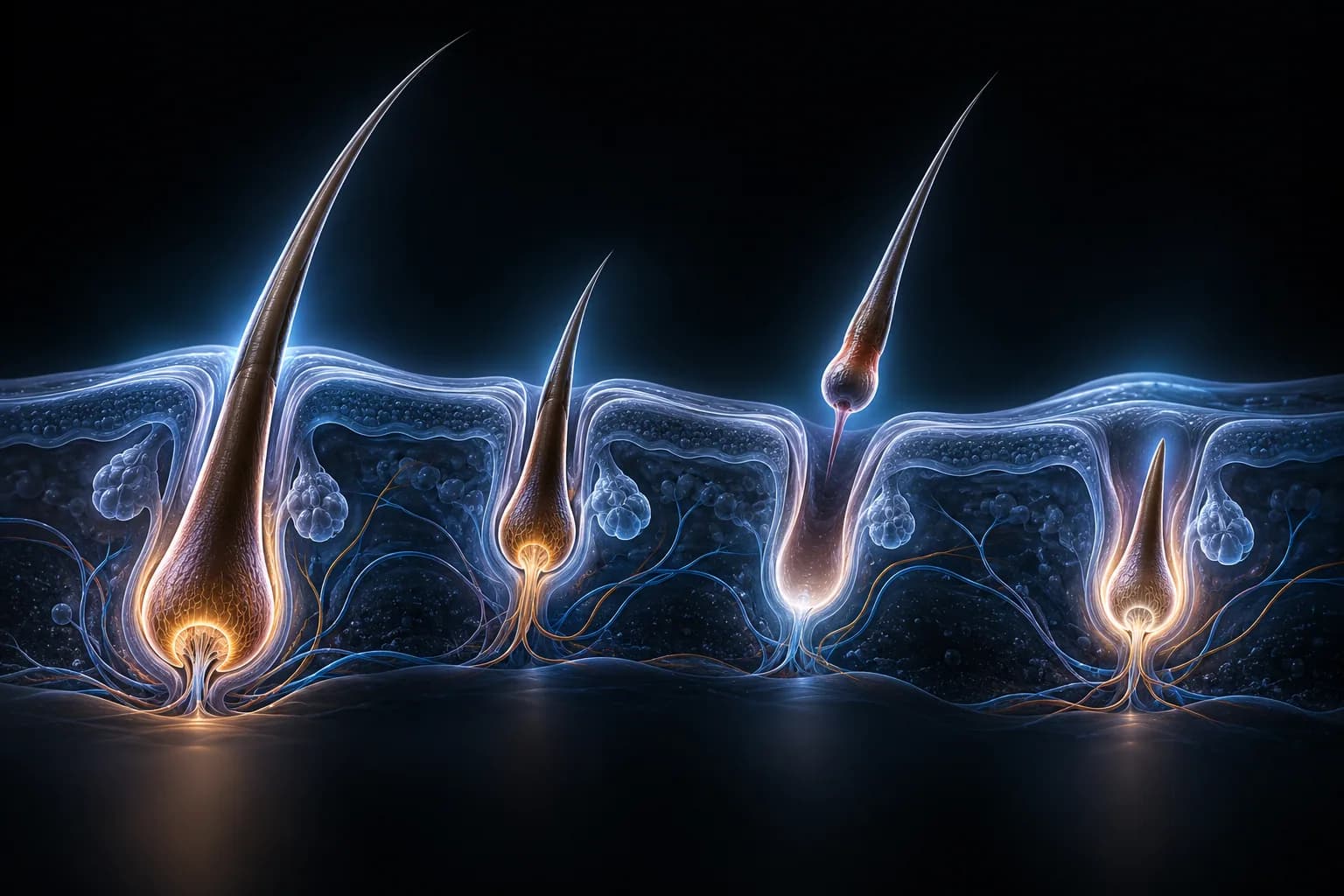
Illustrative image — not a treatment result.
One of the hardest parts of caring for thinning hair is waiting. People often expect a change within days of a new routine. When nothing seems to happen, they feel let down. The reason is how hair grows.
Each hair has its own cycle
A hair root (follicle) does not grow hair all the time. It goes through stages, and every root on your scalp keeps its own timetable. That is why you never lose all your hair at once.
- Growing (anagen): the root makes hair. On the scalp this lasts about 2 to 6 years. It mostly decides how long your hair can grow.
- Slowing (catagen): a short stage of about 2 weeks. Growth stops and the root shrinks.
- Resting (telogen): the hair stays in place but stops growing, for about 3 months.
- Falling (exogen): the old hair falls out, often pushed out by a new hair growing under it.
At any time, about 85–90% of scalp hair roots are growing. The rest are resting or falling. That balance keeps hair looking full.
Why change takes time
Scalp hair grows about 0.35 mm a day — about 1 cm a month. Even when a root starts growing a stronger hair, that hair must grow long enough to be noticed.
In pattern hair loss, hairs grow for a shorter time and the roots slowly get smaller. Treatments try to slow this down, or to help roots that are still active. Neither shows overnight. Published reviews say people usually need at least 4 to 6 months of daily use before they notice a change. The AAD advises using minoxidil for about 6 to 12 months before judging how well it works. Some people do not respond at all. That is why progress is checked, not assumed.
There is a second reason for patience. For pattern hair loss, treatment usually helps only while you use it. Skin doctors say that if you stop, you tend to lose the benefit over time. So a routine you can keep up matters more than a strong one.
What can upset the cycle
- Genes and hormones, which play a big part in pattern hair loss
- Illness, high fever, surgery or having a baby
- A thyroid that is too slow or too fast
- Low iron and some other gaps in your diet
- Sudden diet changes or losing weight fast
- Some medicines, and stopping the birth-control pill
- Strong or long-lasting stress
So many things can upset the cycle that the same change can have very different causes in two people. That is why your plan should fit your history and your roots — not be copied from someone else.
How to track progress fairly
- Take photos in the same place, light and angle each month — do not check the mirror every day
- Keep using your routine as prescribed, so you can see what it does
- Write down any changes — a new medicine, an illness, a new diet
- Compare photos months apart, not days apart
This is why every YHC plan includes monthly progress photos and follow-up reviews. They let your doctor see change that is too slow to notice day to day.
When to see a doctor
- You have tried products on your own for a while and cannot tell if anything helps
- Hair fall has suddenly increased, or is not settling
- You notice patches, scalp pain, redness or flakes
- You want to know if what you see is likely to respond to treatment at all
The next step
Individual results vary, and no honest doctor can promise a timeline. A scan and consultation can give you a clear picture: what is likely going on, if your roots are still active, and a fair way to measure progress. Start your scan whenever you are ready.
Sources
- 1.Anatomy, Hair — Murphrey, Agarwal & Zito (opens in a new tab)
StatPearls (NCBI Bookshelf) · 2023
- 2.
- 3.Terminal hair: function and examples (opens in a new tab)
Cleveland Clinic
- 4.Androgenetic Alopecia — Ho, Sood & Zito (opens in a new tab)
StatPearls (NCBI Bookshelf) · 2024
- 5.What is male pattern hair loss, and can it be treated? (opens in a new tab)
American Academy of Dermatology
- 6.Thinning hair and hair loss: could it be female pattern hair loss? (opens in a new tab)
American Academy of Dermatology
- 7.Telogen effluvium (opens in a new tab)
Cleveland Clinic
Figures are general information from published sources and vary between studies. They are not claims about any YHC product.
Information on this site is for general education and is not a substitute for medical advice. Treatment is prescribed only after a consultation. Individual results vary.