


The science
Know the root. Then treat the hair.
How hair grows, why it gets thinner, and what your doctor’s plan tries to do. We also say what nobody can promise.
Doctor-recommended. Dr. Anil Tyagi picks every product in your plan, for you, after your consultation.
How hair grows
Every hair has a root and a cycle
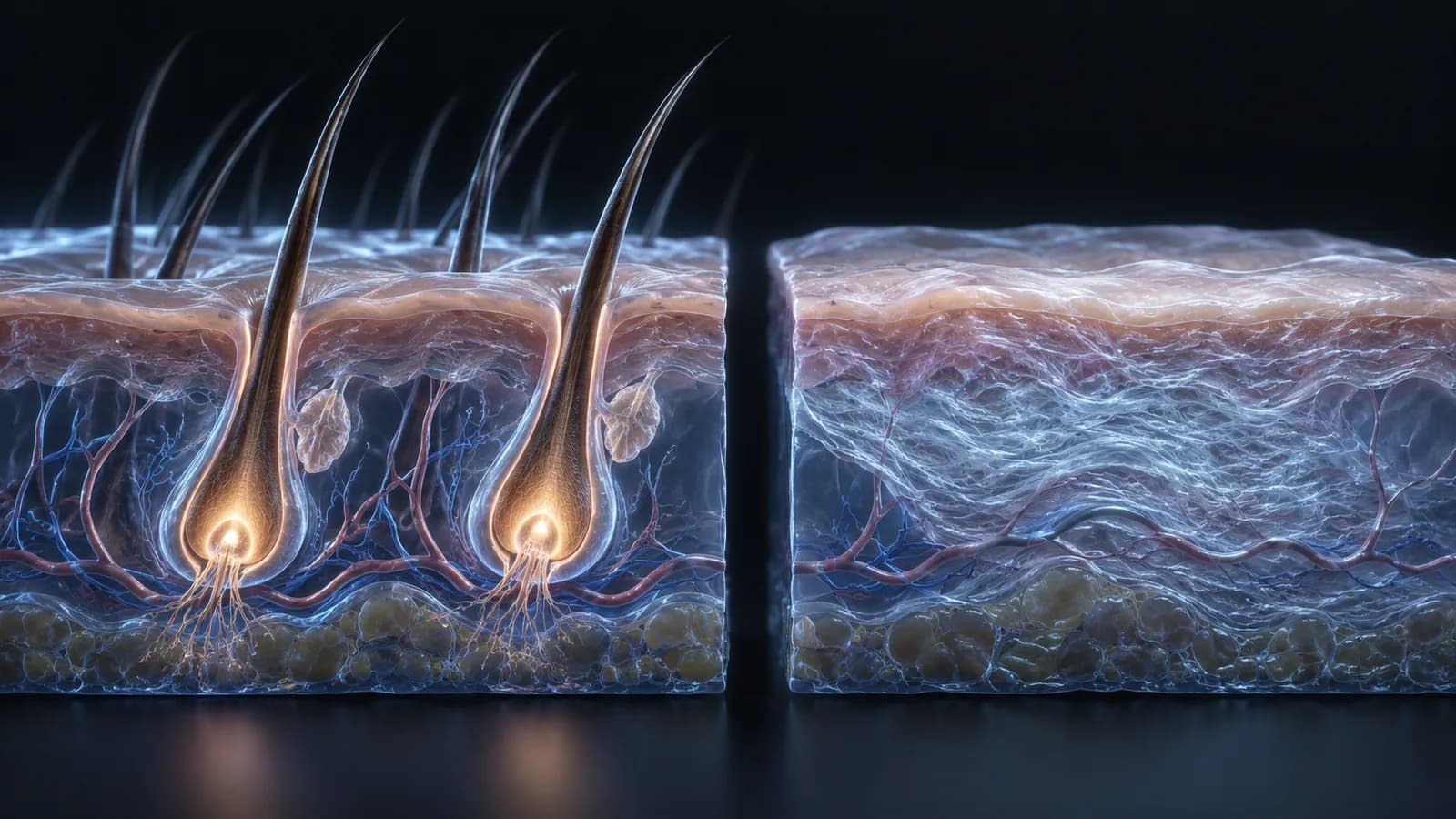
Each hair grows from a tiny root under the skin (the follicle). Every root repeats three steps: it grows for years, rests for a few months, then lets the old hair fall. If the root is healthy, a new hair starts.
Losing some hair every day is normal. What matters is the balance — and whether your roots can still grow.
1 · Anagen
Growing
2 · Catagen
Slowing
3 · Telogen
Resting
- Growing
- The root is deep and busy. Most hairs are here, often for years.
- Slowing
- Growth stops. The root shrinks over a few weeks.
- Resting
- The hair rests, then falls. A living root can start a new one.
What the research says
Hair follows biology, not marketing.
A few proven facts explain why we check your roots first, why a doctor decides your treatment, and why change is judged over months, not weeks. Each fact links to its source.
50–100
hairs shed a day is considered normal[1]
Read moreShow less
Dermatologists describe losing between 50 and 100 hairs a day as normal. Old hairs fall out so new ones can grow in their place, which is why some hair on the brush or pillow is not, by itself, a sign of hair loss.
80,000–120,000
terminal hairs on a typical healthy scalp[2]
Read moreShow less
Most healthy adults have roughly 80,000 to 120,000 terminal (full-thickness) hairs on the scalp.
85–90%
of scalp follicles are in the growth phase at any time[2]
Read moreShow less
The growth (anagen) phase lasts about 2 to 6 years, and at any moment roughly 85–90% of follicles are in it. A short transition phase follows, then a resting (telogen) phase of about three months before the hair sheds.
~1 cm
of growth a month for a scalp hair[3]
Read moreShow less
Each scalp hair grows at about one centimetre a month. Even when a follicle starts producing a stronger hair, it takes months for that hair to grow long enough to be seen — one reason hair changes are slow to judge.
58%
of men aged 30–50 had pattern hair loss in an Indian population study[4]
Read moreShow less
In a population-based study of 1,005 men aged 30 to 50 in India, 58% had some degree of androgenetic (pattern) hair loss, and it was more common with age — from 47.5% in men aged 30–35 to 73.2% in those aged 41–45. Most of those affected had early grades (I–III).
~50%
of men are affected by pattern hair loss by age 50[5]
Read moreShow less
Reviews estimate that androgenetic alopecia affects about half of men by age 50 and around 80% by age 70. Figures vary between populations and studies.
~40%
of women show signs of hair loss by age 50[6]
Read moreShow less
Female pattern hair loss is common and often looks different from male pattern loss — typically diffuse thinning over the top of the scalp rather than a receding hairline. Around 40% of women show signs of hair loss by age 50.
~3 months
is the usual gap between a trigger and heavier shedding[7]
Read moreShow less
In telogen effluvium, a trigger such as illness, high fever, childbirth, surgery or a crash diet is usually found about three months before the shedding starts, although the gap can range from one to six months. That is why a doctor asks what happened in the months before — not just now.
20–160×
magnification used in trichoscopy to examine hair and scalp[8]
Read moreShow less
Trichoscopy is a non-invasive, low-cost examination of the hair and scalp at roughly 20 to 160 times magnification. It looks at follicular openings, the skin around follicles, hair shafts and blood vessels, and can help tell scarring from non-scarring hair loss and early pattern loss from shedding.
≥20%
variation in hair-shaft thickness is a recognised sign of pattern hair loss[9]
Read moreShow less
On trichoscopy, hair-shaft thickness varying by 20% or more is described as a diagnostic sign of androgenetic alopecia, together with more single-hair follicular units at the front of the scalp than at the back.
4–6+ months
of consistent use before improvement is usually visible[5]
Read moreShow less
Medical treatments for pattern hair loss generally need at least four to six months of consistent use before any improvement is noticeable, and ongoing use to keep it. Responses vary, and some people do not respond.
What this means in practice
Shedding, thinning and scarring can look the same in a mirror. They are very different. Treatment can only help roots that are still alive. So we check your roots, and a doctor decides, before any plan.
Stress-related shedding often settles on its own[1]
When shedding follows a stressful event and the stress passes, hair tends to regain its normal fullness within about six to nine months. Shedding that continues, or hair that stops growing back, deserves a proper evaluation.
Pattern hair loss shrinks follicles gradually[5]
In androgenetic alopecia, the growth phase becomes progressively shorter and follicles miniaturise, producing shorter, finer hairs over time. Because the change is gradual, it is often noticed late.
A scarred follicle can no longer grow hair[10]
In scarring forms of hair loss, follicles are replaced by scar tissue, and once a follicle scars it can no longer grow hair. Caught and treated early, some people with scarring hair loss may regrow some hair — so changes along the hairline deserve a prompt look.
Earlier treatment tends to work better[11]
Dermatologists note that people with pattern hair loss who start treatment soon after noticing it tend to see the best results, and that treatment works best when started at the first signs.
Benefits usually last only while treatment continues[12]
For female pattern hair loss, dermatologists advise using minoxidil continuously for about six to 12 months before judging how well it works — and stopping means losing its benefits and gradually shedding more hair. A routine you can keep up matters more than an intense one.
Test first; supplements help when something is actually low[13]
Deficiencies that are found should be corrected, but there is little evidence that supplements help hair in people who are not deficient, and some can worsen hair loss or cause toxicity. Iron and thyroid checks are guided by your history and symptoms; a normal ferritin result does not always rule out iron deficiency.
Hair loss from a medical cause often improves once it is treated[14]
Temporary hair loss can follow illness, stress, weight loss or iron deficiency, and hair loss caused by a medical condition usually stops or grows back once you have recovered. Finding the cause is the first step.
References
- 1.American Academy of Dermatology (opens in a new tab)Do you have hair loss or hair shedding?
- 2.StatPearls (NCBI Bookshelf) (2023) (opens in a new tab)Anatomy, Hair — Murphrey, Agarwal & Zito
- 3.Cleveland Clinic (opens in a new tab)Terminal hair: function and examples
- 4.International Journal of Trichology (2009) (opens in a new tab)Male androgenetic alopecia: population-based study in 1,005 subjects — Krupa Shankar et al.
- 5.StatPearls (NCBI Bookshelf) (2024) (opens in a new tab)Androgenetic Alopecia — Ho, Sood & Zito
- 6.DermNet (opens in a new tab)Female pattern hair loss
- 7.StatPearls (NCBI Bookshelf) (2024) (opens in a new tab)Telogen Effluvium — Hughes, Syed & Saleh
- 8.DermNet (2022) (opens in a new tab)Trichoscopy — Sadek et al.
- 9.DermNet (2022) (opens in a new tab)Trichoscopy of generalised non-cicatricial hair loss — Sadek
- 10.American Academy of Dermatology (opens in a new tab)Frontal fibrosing alopecia: overview
- 11.American Academy of Dermatology (opens in a new tab)What is male pattern hair loss, and can it be treated?
- 12.American Academy of Dermatology (opens in a new tab)Thinning hair and hair loss: could it be female pattern hair loss?
- 13.Dermatology Practical & Conceptual (2017) (opens in a new tab)Diet and hair loss: effects of nutrient deficiency and supplement use — Guo & Katta
- 14.NHS (opens in a new tab)Hair loss
These facts are general information from published sources. They are not claims about our products. Figures vary between studies and groups of people. This is not medical advice. Only a doctor who has checked you can say what applies to your hair.
 Illustrative photo · scalp parting, close up
Why hair thins
Different causes need different care
Two people can look the same but have different causes. The scan, the health form and the consultation help find yours. This is general information, not a diagnosis.
- Family pattern thinning
- Hair in some areas slowly grows finer and shorter. It is common and usually slow.
- Shedding after a shock
- Fever, illness, stress, surgery or a crash diet can make lots of hair fall at once, a few months later.
- Food and health
- Low iron, low vitamin D or thyroid problems can play a part. That is why the doctor asks.
- Scalp problems
- Dandruff, itching or redness can make the scalp a harder place for hair to grow.
What is inside
Every ingredient has a job
What each product contains and why. Your doctor sets the strength and the mix.
Prescription medicine · Your doctor decides if you need it
Hair Regrowth Solution
- Redensyl
- Branded cosmetic active listed on the label
- Anagain
- Pea-sprout extract (branded active) listed on the label
- Procapil
- Branded cosmetic active listed on the label
- Capilia Longa
- Turmeric-derived branded active listed on the label
- Finasteride
- Prescription medicine — used only when the doctor prescribes it
Food supplement · Your doctor decides if you need it
Hair Nourishing Tablets
- Green tea (Camellia sinensis)
- Botanical listed on the label
- Bhringraj (Eclipta prostrata)
- Herb traditionally used in Ayurvedic hair care
- Pumpkin seed (Cucurbita pepo)
- Seed extract listed on the label
- Iron
- Mineral
- Zinc
- Mineral
- Vitamin A
- Vitamin
- Copper
- Trace mineral
- Folic acid
- B-group vitamin
- Vitamin B5
- B-group vitamin
- Biotin
- B-group vitamin
Ayurvedic · Your doctor decides if you need it
Hair Regrowth Capsules
- Amla (Phyllanthus emblica)
- Fruit listed in the Ayurvedic blend
- Arjun (Terminalia arjuna)
- Bark listed in the Ayurvedic blend
- Bhringraj (Eclipta prostrata)
- Herb traditionally used in Ayurvedic hair care
- Shatavari (Asparagus racemosus)
- Root listed in the Ayurvedic blend
- Shuddh lakh (Laccifer lacca)
- Purified lac resin listed in the blend
- Ashwagandha (Withania somnifera)
- Root listed in the Ayurvedic blend
Individual results vary.
The honest part
What we know — and what we don’t
What we know
- Hair grows in cycles. A hair root must be alive to grow a new hair.
- Thinning has many causes. The right care depends on your cause.
- Change is slow. You see it over months, not days.
- Using your plan every day, as your doctor says, matters most.
What nobody can promise
- Exactly how you will respond. Individual results vary.
- How much hair, if any, will grow back.
- Whether a scan alone can explain your case. That is why a doctor checks it.
See what is happening at your roots.
Start with a free 3D scan. A doctor checks it before anything is prescribed.